
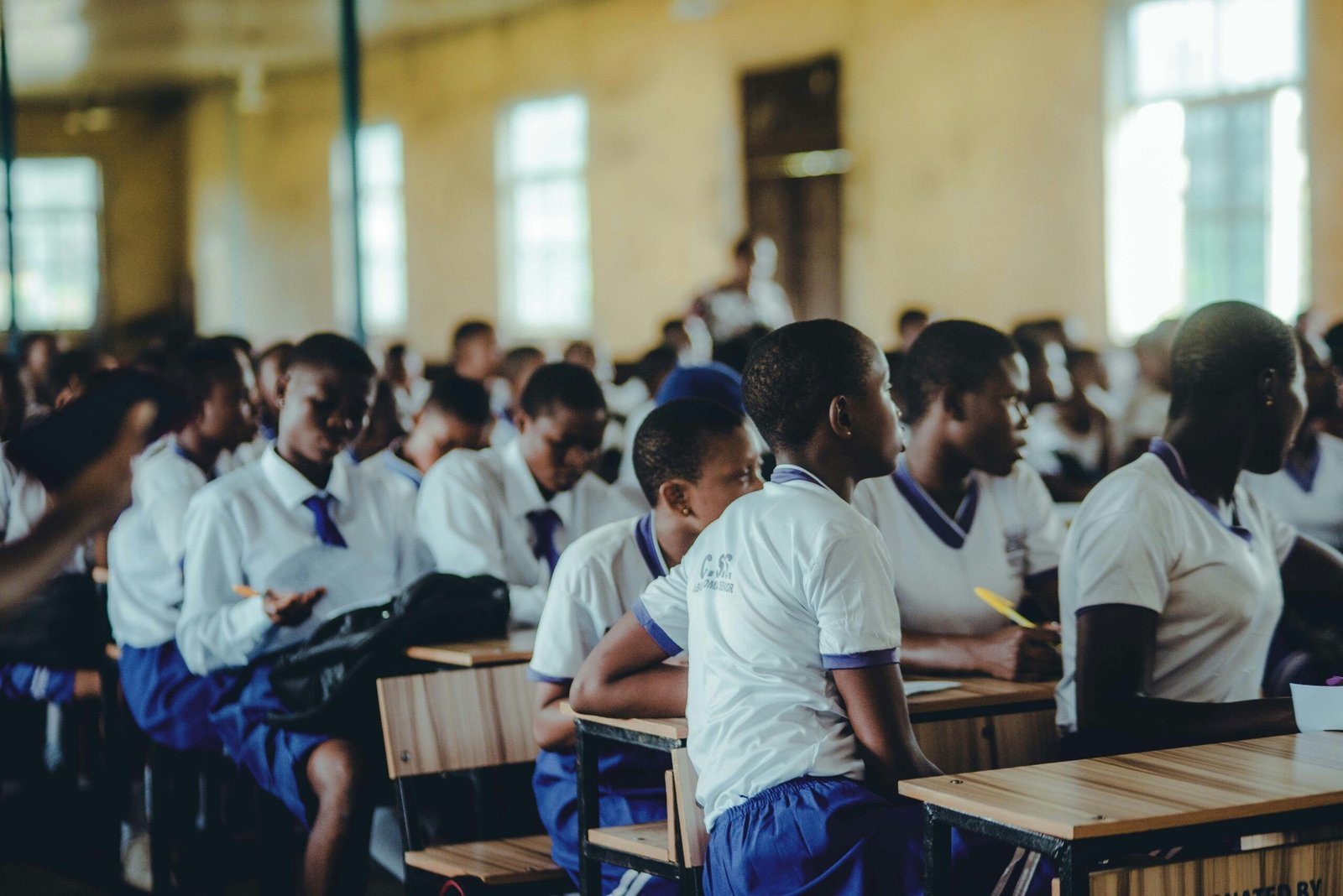
Let’s talk about the word “free.” It’s a beautiful word, right? Politicians absolutely love it. They stand on giant podiums, microphones buzzing, sweeping their hands across the crowd, and declare, “Education is now free!” The crowds cheer. The headlines write themselves. And honestly, why shouldn’t they? On paper, it sounds like the ultimate equalizer, the silver bullet to poverty. The great, towering barrier of tuition fees—finally smashed.
But when the political dust settles, the cameras leave, and the school year actually begins, you realize something brutal and undeniably real. Free education in Africa is rarely, if ever, actually free.
In fact, sometimes the “free” part—the actual tuition—is just a tiny fraction of the total cost of getting a kid into a classroom and keeping them there until they graduate. It’s like being invited to a massive, all-you-can-eat buffet for free, but you show up and find out you have to buy your own plate, rent the chair you sit on, and pay for the air you breathe while chewing. It is an illusion, a magic trick where the heavy financial lifting is just hidden behind the curtain.
The Logistics of Just Getting There: Transportation, Feeding, and the Scramble for a Bed
Let’s start with the absolute, bare-bones basics. You don’t just magically teleport into a classroom when you get admission, do you? There is the sheer, physical logistics of moving a human being from their front door to a school desk every single day.
Transportation is a beast. If you live in a rural area or the outskirts of a bustling city, “free school” might be three villages over or a chaotic two-hour commute away. So what happens? The kid either walks miles at dawn, arriving exhausted, sweaty, and dusty before the first bell even rings, or the parents have to scrape together daily lorry, taxi, or trotro fares. And guess what? Transport fares do not care about your free tuition policy. When global fuel prices jump, the transport fare jumps. Suddenly, a family that couldn’t afford tuition in the first place is now suffocating under the crushing, non-negotiable weight of daily transport costs.
Then, they have to eat. This shouldn’t be controversial: you cannot feed a hungry mind. You can put the greatest, most inspiring teacher in the world in front of a starving student, and all that kid is going to learn is the rhythm of their own stomach rumbling. Feeding a growing teenager away from home is deeply expensive. Parents have to provide “chop money”—daily pocket money for food. When inflation hits the local market, the price of a simple bowl of rice, waakye, or beans goes up. The school might be free, but the calories required to stay awake in it are violently tied to the economy.
And what about the students who can’t commute? High schools and universities are often centralized in larger towns or cities. So, you have a brilliant kid from a small farming community who gets admission to a top-tier school in the capital. Fantastic, right? A dream come true. But the “free” policy rarely builds enough dormitories to house all these new students. So, these kids are thrust into the private hostel market.
Oh, let’s be real—the private student housing market is ruthless. Landlords know the students are entirely desperate, so they charge exorbitant, jaw-dropping rent for cramped, poorly ventilated rooms. A family might not be paying a dime to the school administration, but they are emptying their life savings—or taking out high-interest loans—just to line the pockets of a landlord so their child has a thin mattress to sleep on. It’s an insane paradox.
Death by a Thousand Paper Cuts: The “Invisible Fees”
Okay, so let’s say the kid made it to school, they have a roof over their head, and they managed to buy some lunch. Now the actual learning is supposed to start. And here come the “invisible fees.” This is where the shiny illusion of free education completely shatters. It is quite literally death by a thousand paper cuts.
Tuition is waived, sure. But because government systems are chronically underfunded, the schools themselves are starving for cash. So, the operating costs are quietly, aggressively passed down to the students.
Let’s talk about the handouts. If you’ve ever been through the African educational system, you know exactly what I mean by handouts. The teacher or lecturer compiles their course notes, prints them into a flimsy booklet, and mandates that every single student buys a copy. Sometimes, it’s not even a subtle suggestion; they outright hint that if you don’t buy their specific handout, your assignment might “accidentally” get lost, or you won’t pass the continuous assessment. It feels like extortion disguised as pedagogy. Why does it happen? Often because the teachers themselves are underpaid and are using the students to supplement their survival. It’s a trickle-down economy of stress.
Then there is the constant, never-ending printing. Assignments usually can’t be handwritten anymore; they must be typed and printed. Every week, students are bleeding small amounts of cash at the campus internet café just to submit their homework.
And what if you are a science student? Or studying visual arts or technical drawing? The government certainly isn’t buying your paints, your canvases, your lab coats, or the specific tools you need for practicals. You are funding your own practical education out of pocket. You have group projects where everyone is expected to contribute cash to buy materials, build a model, or travel to a research site.
These aren’t one-off, start-of-the-year expenses; they are continuous, relentless, weekly demands. Ten cedis here, fifty naira there, five hundred shillings tomorrow. For a family living right on the financial edge, these unpredictable, mandatory micro-payments are an absolute nightmare. You can’t budget for them because you never know when a teacher is going to demand a new textbook, or when the school will suddenly invent a new mandatory “departmental due.” PTA dues, computer maintenance levies, examination printing fees—they just keep changing the names of the fees, but the money still leaves the parent’s pocket.
The Toll on the Mind and the Clock: Emotional and Opportunity Costs
But honestly, the money is only half the story. If we are really, truly talking about hidden costs, we have to talk about the things you can’t put a neat little price tag on. The emotional and opportunity costs. This is the stuff that grinds people down from the inside out.
Imagine being a student who knows their mother sells tomatoes in the scorching open market all day just to send that weekly “chop money.” Every time a teacher asks for money for a new pamphlet, that student feels a physical spike of anxiety. They have to make the dreaded phone call home. “Ma, they say we need another 50 for a practical.” They hear the heavy sigh on the other end of the line. The long silence. The guilt is absolutely crushing.
You sit in class, supposedly getting this amazing “free” education, but your mind is entirely consumed by the math of your family’s survival. You aren’t thinking about the complexities of algebra; you are thinking about whether your younger siblings ate that morning so you could pay for your printed assignment. This is a massive cognitive load. It’s a brutal tax on their mental health. We are raising an entire generation of anxious, stressed-out students who are operating in a constant state of fight-or-flight financial survival mode.
And then, there is the opportunity cost. Time is money—literally—for many families. When a teenager goes to school for eight hours a day, that is a pair of capable hands removed from the family farm, the family shop, or the market stall. In more affluent societies, kids going to school is just what kids do. But in many parts of Africa, a teenager is a vital, functioning gear in the household economy.
By keeping them in a classroom, the family is actively losing daily income. The parents make that massive sacrifice hoping the education will pay off eventually in the future. But while that kid is in school learning geography, the family is tangibly poorer today. The opportunity cost of “free” education is the immediate lost labor that keeps a family afloat. It’s a massive gamble. And sadly, when the hidden fees become too much, it is often the young girls who are pulled out of school first, sent back to domestic labor or the markets to help offset the costs so their brothers can stay in class.
The Innovation Warriors
Let’s dig deeper into the mindset required to navigate this, the sheer, unapologetic grit it takes. Because the truth is, the system almost expects you to fail if you aren’t financially padded. The “free” label is almost a form of societal gaslighting. It makes people look at struggling students and say, “What’s your problem? Why are you failing? The government is paying for it!” This profound lack of empathy is a hidden cost, too. It alienates the poorest students.
It creates a brutal, silent hierarchy on campus. There are the kids who have money, who buy all the handouts on day one, who eat three hot meals, who sleep in the premium, air-conditioned hostels. And then there are the innovation warriors—the kids who are literally fighting for their lives just to exist in the exact same academic space.
These warriors are doing complex mental gymnastics just to survive the week. They skip meals to pay for printing. They borrow a friend’s handout and stay up until 2 AM copying it out by hand because they can’t even afford the photocopies. They form study groups not just to learn, but to pool resources—one person buys the core textbook, and six people share it.
We say that creativity results from connecting people together, right? Well, poverty forces a very specific, traumatic kind of creativity. It forces collaboration born out of absolute, back-to-the-wall desperation. Yes, it builds incredible resilience. People love to write articles romanticizing African resilience. But let’s be totally real here—nobody wants to be this resilient. It is exhausting. It means that your youthful energy isn’t going into innovating new solutions for old problems; your energy is going into figuring out how to afford a bus ride on a Thursday.
Redefining What “Free” Actually Means
Think about the sheer amount of human talent we are leaving on the table. If you’re an individual with creativity, it not only makes your life more colorful and fulfilling but can also, in more general and practical terms, actually create better solutions for old problems and encourage new ones to emerge. Creativity makes life richer by providing new media to express ideas. Creativity enables the most unique solutions to problems.
But when the educational system bleeds you dry with invisible fees and logistical nightmares, your creativity is hijacked. It is violently diverted from academic brilliance into pure, unadulterated survival tactics. How many future engineers, brilliant doctors, or groundbreaking artists are sitting in our classrooms right now, entirely consumed by the anxiety of their next meal or the rent they owe for a dingy room?
All in all, creativity is not just a recipe; but it is rather an approach to get people growing. The three foci of creativity: Nurturing curiosity, embracing experimentation with hands-on learning experiences in order to explore, and collaboration with other innovation warriors—these things require a foundation of peace. You cannot experiment when you are terrified. You cannot nurture curiosity when you are hungry.
If we truly want an education system that transforms the continent, we have to look far beyond the tuition waiver. We have to look at the holistic, messy, real-world cost of attending school. We have to subsidize transport for students. We have to invest heavily in campus infrastructure so students aren’t thrown to the wolves in the private housing market. We desperately need to crack down on the extortionate culture of mandatory paid handouts and ever-shifting hidden levies.
Such people—these students who fight through the friction every single day—benefit their own lives greatly through their sheer willpower. So it seems reasonable to assume that society as a whole will benefit even more from having them around, thriving instead of just surviving. They contribute in every way to making the world a far more creative, active, and interesting place.
It is time we stop making them pay such a heavy, crushing, and completely hidden price for a gift we loudly claim we already gave them. Let’s make “free” actually mean free.