
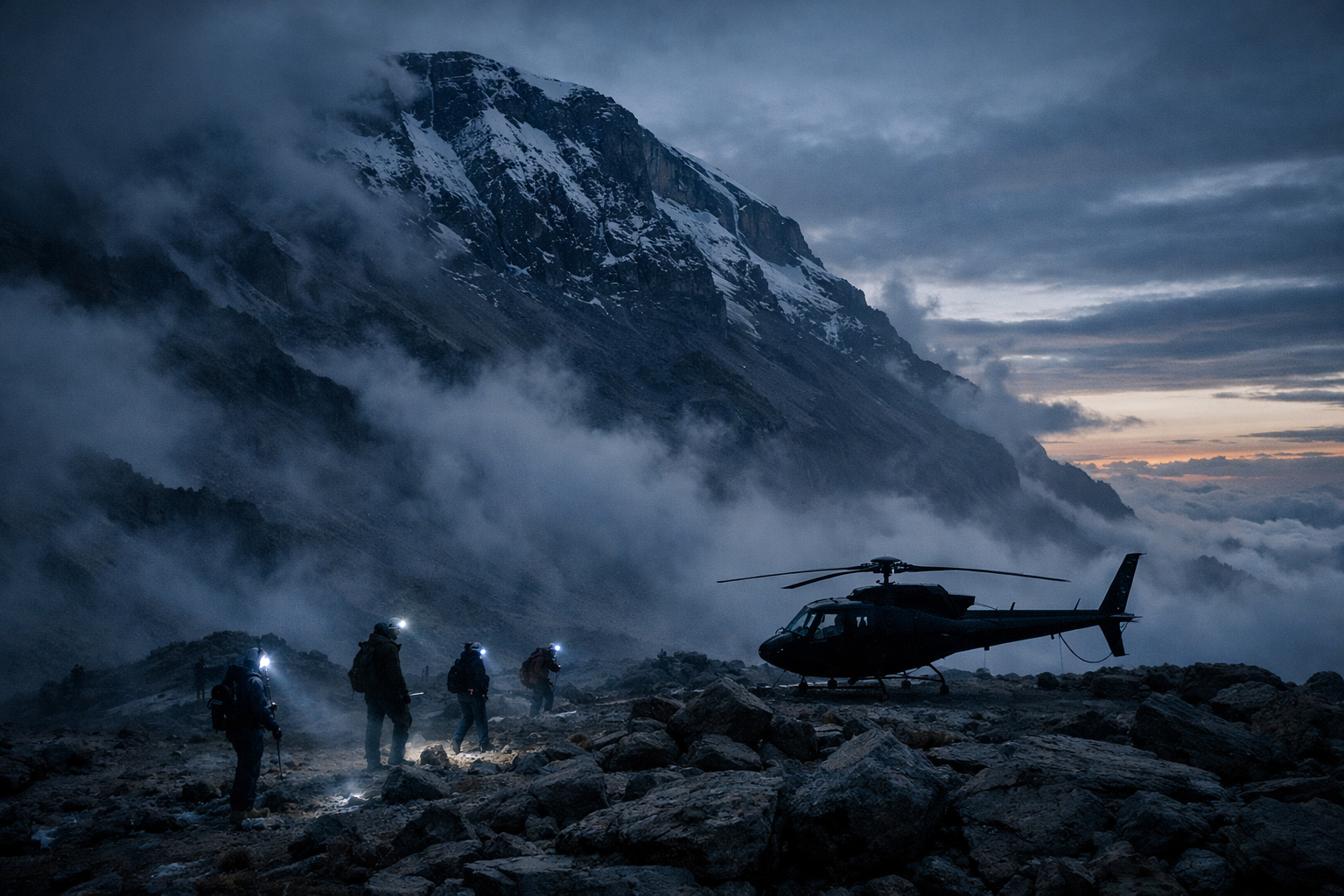
Kilimanjaro, Tanzania — December 24, 2025
A tragic helicopter crash during a high-risk medical evacuation on Mount Kilimanjaro, Africa’s tallest mountain, has claimed the lives of five people, reigniting debate over high-altitude aviation safety, rescue protocols, and tourism risks in East Africa.
The incident occurred on the evening of December 24, 2025, at approximately 5:45 p.m. East Africa Time, on the southeastern slopes of the mountain near Barafu Camp, a critical staging area for climbers attempting the summit.
What Happened on Mount Kilimanjaro
According to official aviation and park authorities, the helicopter went down in the Barafu Valley, between Barafu Camp and the Kibo Summit, at an estimated altitude of 4,670 to 4,700 meters (over 15,400 feet).
The aircraft was conducting a medical evacuation mission, responding to an emergency involving climbers suffering from serious health complications—likely linked to altitude sickness, a common and potentially fatal condition at extreme elevations.
All five occupants onboard died, and the helicopter was completely destroyed upon impact. Rescue efforts by nearby mountain guides and emergency responders confirmed no survivors at the crash site.
Victims Identified
Authorities later confirmed the identities of those who lost their lives:
One Zimbabwean pilot
One Tanzanian medical professional (doctor or paramedic)
One Tanzanian mountain guide
Two Czech tourists, who were being evacuated from the mountain
Officials clarified that the victims were not clients of all tour operators on the mountain. Some companies publicly confirmed that none of their guides or climbers were involved.
Condolences have poured in from government officials, aviation authorities, and tourism stakeholders, praising the courage of the rescue crew who routinely operate under extreme conditions.
Aircraft and Operator Details
The helicopter involved was identified as an Airbus Helicopters H125 (AS 350B3e)—a model widely regarded as capable of high-altitude operations and frequently used for rescues in mountainous regions.
Registration: 5H-KMA
Manufacturer Serial Number: 7946
Operator: KiliMedAir Aviation, a Tanzanian company operating under Savannah Aviation Limited
KiliMedAir specializes in medical evacuations, aerial rescues, and scenic flights around Mount Kilimanjaro and is registered with the Tanzania Civil Aviation Authority (TCAA).
No publicly documented fatal accidents involving the operator were recorded prior to this crash. However, as of this report, the company has not released an official public statement.
Cause of the Crash: What Investigators Say
The exact cause of the crash remains unknown, and authorities have urged the public to avoid speculation.
Investigators are examining several possible contributing factors, including:
Rapidly changing weather conditions
Thin air at extreme altitude reducing engine lift
Mechanical or technical malfunction
Operational challenges unique to high-mountain rescues
A formal investigation has been launched by the Tanzania Civil Aviation Authority, working alongside the Tanzania Airports Authority (TAA), Kilimanjaro National Park Authority (TANAPA), and national police.
In a statement, aviation officials confirmed that the investigation will follow international aviation safety standards.
A Rare but Serious Incident
Helicopter crashes on Mount Kilimanjaro are extremely rare. Records indicate the last known similar incident occurred in November 2008, when another helicopter accident reportedly killed four people during mountain operations.
Despite its reputation as a non-technical climb, Kilimanjaro presents serious risks. Experts estimate that up to 75% of climbers experience some form of altitude sickness, making emergency evacuations a routine—but dangerous—necessity.
Impact on Tourism and Safety Debate
Mount Kilimanjaro attracts around 50,000 climbers annually, making it a cornerstone of Tanzania’s tourism economy.
While park authorities have stated that climbing activities continue under strict guidance, the crash has intensified scrutiny over:
Oversight of high-altitude aviation
Rescue preparedness and aircraft limitations
Commercial pressures in adventure tourism
Emergency response coordination in remote areas
Tourism officials stress that travelers should only use licensed operators, ensure adequate insurance coverage, and follow proper acclimatization schedules.
Other major tourism destinations in Tanzania, including Serengeti National Park and Zanzibar, remain unaffected.
Public Reaction and Calls for Accountability
The tragedy has triggered an outpouring of grief online, alongside calls for:
Improved aviation safety oversight
Transparent investigation results
Stronger risk-management policies
Experts and users alike have cautioned against misinformation, urging reliance on official statements from TCAA and TANAPA as the investigation continues.
What Comes Next
Recovery operations remain challenging due to the rugged terrain and high altitude, but authorities say lessons learned from the crash could lead to improved rescue protocols, stricter weather assessments, and enhanced equipment standards.
Further updates are expected once investigators complete their analysis.
For now, the incident stands as a sobering reminder of the inherent dangers of high-altitude rescue missions, even on well-established tourist routes.